Chapter 6 One-to-One and Recursive Relationships
Self-reflection is the school of wisdom.
Baltasar Gracián, The Art of Worldly Wisdom, 1647
Learning objectives
Students completing this chapter will be able to
model one-to-one and recursive relationships;
define a database with one-to-one and recursive relationships;
write queries for a database with one-to-one and recursive relationships.
An organizational chart, as shown in the following diagram, can be modeled with several relationships.
The Expeditioner’s organizational chart

Modeling a one-to-one relationship
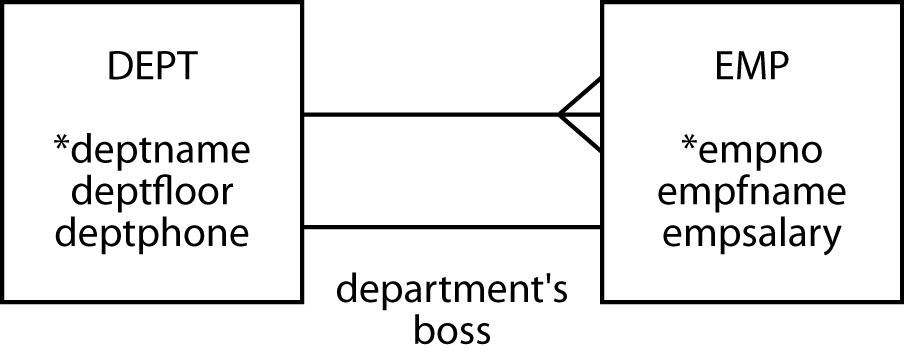
Initially, the organization chart appears to record two relationships. First, a department has one or more employees, and an employee belongs to one department. Second, a department has one boss, and a person is boss of only one department. That is, boss is a 1:1 relationship between DEPT and EMP. The data model for this situation is shown.
A data model illustrating a 1:m and 1:1 relationship
MySQL Workbench version of a 1:m and 1:1 relationship
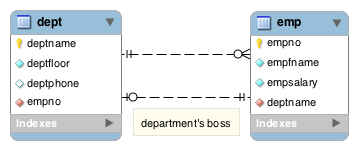
As a general rule, the 1:1 relationship is labeled to avoid confusion because the meaning of such a relationship cannot always be inferred. This label is called a relationship descriptor. The 1:m relationship between DEPT and EMP is not labeled because its meaning is readily understood by reading the model. Use a relationship descriptor when there is more than one relationship between entities or when the meaning of the relationship is not readily inferred from the model.
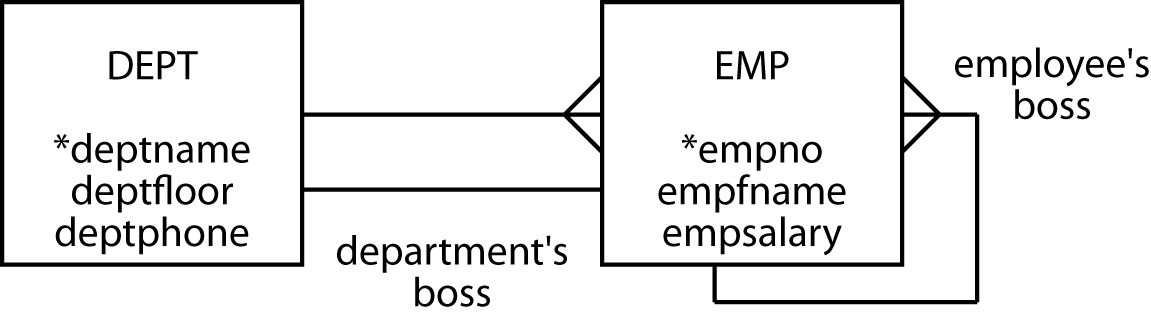
If we think about this problem, we realize there is more to boss than just a department. People also have a boss. Thus, Alice is the boss of all the other employees. In this case, we are mainly interested in who directly bosses someone else. So, Alice is the direct boss of Ned, Todd, Brier, and Sophie. We need to record the person-boss relationship as well as the department-boss relationship.
The person-boss relationship is a recursive 1:m relationship because it is a relationship between employees—an employee has one boss and a boss can have many employees. The data model is shown in the following figure.
A data model illustrating a recursive 1:m relationship
MySQL Workbench version of a recursive 1:m relationship
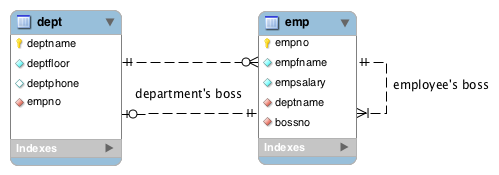
It is a good idea to label the recursive relationship, because its meaning is often not obvious from the data model.
Mapping a one-to-one relationship
Since mapping a 1:1 relationship follows the same rules as for any other data model, the major consideration is where to place the foreign key(s). There are three alternatives:
Put the foreign key in dept.
Doing so means that every instance of dept will record the empno of the employee who is boss. Because it is mandatory that all departments, in this case have a boss, the foreign key will always be non-null.Put the foreign key in emp.
Choosing this alternative means that every instance of emp should record deptname of the department this employee bosses. Since many employees are not bosses, the value of the foreign key column will generally be null.Put a foreign key in both dept and emp.
The consequence of putting a foreign key in both tables in the 1:1 relationship is the combination of points 1 and 2.
The best approach is to put the foreign key in dept, because it is mandatory for each department to have a boss, and the foreign key will always be non-null.
Mapping a recursive one-to-many relationship
A recursive 1:m relationship is mapped like a standard 1:m relationship.
An additional column, for the foreign key, is created for the entity at
the “many” end of the relationship. Of course, in this case the “one”
and “many” ends are the same entity, so an additional column is added to
emp. This column contains the key empno of the “one” end of the
relationship. Since empno is already used as a column name, a
different name needs to be selected. In this case, it makes sense to
call the foreign key column bossno because it stores the boss’s
employee number.
The mapping of the data model is shown in the following table. Note that
deptname becomes a column in emp, the “many” end of the 1:m
relationship, and empno becomes a foreign key in dept, an end of the
1:1 relationship.
The tables dept and emp
| deptname | deptfloor | deptphone | empno |
|---|---|---|---|
| Management | 5 | 2001 | 1 |
| Marketing | 1 | 2002 | 2 |
| Accounting | 4 | 2003 | 5 |
| Purchasing | 4 | 2004 | 7 |
| Personnel & PR | 1 | 2005 | 9 |
| empno | empfname | empsalary | deptname | bossno |
|---|---|---|---|---|
| 1 | Alice | 75000 | Management | |
| 2 | Ned | 45000 | Marketing | 1 |
| 3 | Andrew | 25000 | Marketing | 2 |
| 4 | Clare | 22000 | Marketing | 2 |
| 5 | Todd | 38000 | Accounting | 1 |
| 6 | Nancy | 22000 | Accounting | 5 |
| 7 | Brier | 43000 | Purchasing | 1 |
| 8 | Sarah | 56000 | Purchasing | 7 |
| 9 | Sophie | 35000 | Personnel & PR | 1 |
If you examine emp, you will see that the boss of the employee with
empno = 2 (Ned) has bossno = 1. You can then look up the row in
emp with empno = 1 to find that Ned’s boss is Alice. This “double
lookup” is frequently used when manually interrogating a table that
represents a recursive relationship. Soon you will discover how this is
handled with SQL.
Here is the SQL to create the two tables:
CREATE TABLE dept (
    deptname        VARCHAR(15),
    deptfloor       SMALLINT NOT NULL,
    deptphone       SMALLINT NOT NULL,
    empno           SMALLINT NOT NULL,
    PRIMARY KEY(deptname));
CREATE TABLE emp (
empno SMALLINT,
empfname VARCHAR(10),
empsalary DECIMAL(7,0),
deptname VARCHAR(15),
bossno SMALLINT,
PRIMARY KEY(empno),
CONSTRAINT fk_belong_dept FOREIGN KEY(deptname)
REFERENCES dept(deptname),
CONSTRAINT fk_has_boss FOREIGN KEY(bossno)
REFERENCES emp(empno));You will notice that there is no foreign key definition for empno in
dept (the 1:1 department’s boss relationship). Why? Observe that
deptname is a foreign key in emp. If we make empno a foreign key
in dept, then we have a deadly embrace. A new department cannot be
added to the dept table until there is a boss for that department
(i.e., there is a person in the emp table with the empno of the
boss); however, the other constraint states that an employee cannot be
added to the emp table unless there is a department to which that
person is assigned. If we have both foreign key constraints, we cannot
add a new department until we have added a boss, and we cannot add a
boss until we have added a department for that person. Nothing, under
these circumstances, can happen if both foreign key constraints are in
place. Thus, only one of them is specified.
In the case of the recursive employee relationship, we can create a
constraint to ensure that bossno exists for each employee, except of
course the person, Alice, who is top of the pyramid. This form of
constraint is known as a self-referential foreign key. However, we
must make certain that the first person inserted into emp is Alice.
The following statements illustrate that we must always insert a
person’s boss before we insert the person.
INSERT INTO emp (empno, empfname, empsalary, deptname) VALUES (1,'Alice',75000,'Management');
INSERT INTO emp VALUES (2,'Ned',45000,'Marketing',1);
INSERT INTO emp VALUES (3,'Andrew',25000,'Marketing',2);
INSERT INTO emp VALUES (4,'Clare',22000,'Marketing',2);
INSERT INTO emp VALUES (5,'Todd',38000,'Accounting',1);
INSERT INTO emp VALUES (6,'Nancy',22000,'Accounting',5);
INSERT INTO emp VALUES (7,'Brier',43000,'Purchasing',1);
INSERT INTO emp VALUES (8,'Sarah',56000,'Purchasing',7);
INSERT INTO emp VALUES (9,'Sophie',35000,'Personnel',1);
In more complex modeling situations, such as when there are multiple relationships between a pair of entities, use of a FOREIGN KEY clause may result in a deadlock. Always consider the consequences of using a FOREIGN KEY clause before applying it.
❓Skill builder A consulting company has assigned each of its employees to a specialist group (e.g., database management). Each specialist group has a team leader. When employees join the company, they are assigned a mentor for the first year. One person might mentor several employees, but an employee has at most one mentor.
Querying a one-to-one relationship
Querying a 1:1 relationship presents no special difficulties but does allow us to see additional SQL features.
List the salary of each department’s boss.
SELECT empfname, deptname, empsalary FROM emp
    WHERE empno IN (SELECT empno FROM dept);
or
SELECT empfname, dept.deptname, empsalary
    FROM emp JOIN dept
ON dept.empno = emp.empno;| empfname | deptname | empsalary |
|---|---|---|
| Todd | Accounting | 38000 |
| Alice | Management | 75000 |
| Ned | Marketing | 45000 |
| Sophie | Personnel | 35000 |
| Brier | Purchasing | 43000 |
Querying a recursive 1:m relationship
Querying a recursive relationship is puzzling until you realize that you
can join a table to itself by creating two copies of the table. In SQL,
you use the WITH clause, also known as the common table expression
(CTE) to create a temporary copy, a table alias. First, use WITH to
define two aliases, wrk and boss for emp. Table aliases are
required so that SQL can distinguish which copy of the table is
referenced. To demonstrate:
Find the salary of Nancy’s boss.
First, use WITH to define two aliases, wrk and boss for emp.
WITH
wrk AS (SELECT * FROM emp),
boss AS (SELECT * FROM emp)
SELECT wrk.empfname, wrk.empsalary,boss.empfname, boss.empsalary
    FROM wrk JOIN boss
        ON wrk.bossno = boss.empno
        WHERE wrk.empfname = 'Nancy';
Many queries are solved by getting all the data you need to answer the
request in one row. In this case, the query is easy to answer once the
data for Nancy and her boss are in the one row. Thus, think of this
query as joining two copies of the table emp to get the worker and her
boss’s data in one row. Notice that there is a qualifier (wrk and
boss) for each copy of the table to distinguish between them. It helps
to use a qualifier that makes sense. In this case, the wrk and boss
qualifiers can be thought of as referring to the worker and boss tables,
respectively. You can understand how the query works by examining the
following table illustrating the self-join.
| wrk | boss | ||||||||
|---|---|---|---|---|---|---|---|---|---|
| empno | empfname | empsalary | deptname | bossno | empno | empfname | empsalary | deptname | bossno |
| 2 | Ned | 45000 | Marketing | 1 | 1 | Alice | 75000 | Management | |
| 3 | Andrew | 25000 | Marketing | 2 | 2 | Ned | 45000 | Marketing | 1 |
| 4 | Clare | 22000 | Marketing | 2 | 2 | Ned | 45000 | Marketing | 1 |
| 5 | Todd | 38000 | Accounting | 1 | 1 | Alice | 75000 | Management | |
| 6 | Nancy | 22000 | Accounting | 5 | 5 | Todd | 38000 | Accounting | 1 |
| 7 | Brier | 43000 | Purchasing | 1 | 1 | Alice | 75000 | Management | |
| 8 | Sarah | 56000 | Purchasing | 7 | 7 | Brier | 43000 | Purchasing | 1 |
| 9 | Sophie | 35000 | Personnel & PR | 1 | 1 | Alice | 75000 | Management |
The result of the SQL query is now quite clear once we apply the WHERE clause (see the highlighted row in the preceding table):
WITH
wrk AS (SELECT * FROM emp),
boss AS (SELECT * FROM emp)
SELECT wrk.empfname, wrk.empsalary,boss.empfname, boss.empsalary
    FROM wrk JOIN boss
        ON wrk.bossno = boss.empno
WHERE wrk.empfname = 'Nancy';| empfname | empsalary | empfname | empsalary |
|---|---|---|---|
| Nancy | 22000 | Todd | 38000 |
Find the names of employees who earn more than their boss.
This would be very easy if the employee and boss data were in the same row. We could simply compare the salaries of the two people. To get the data in the one row, we repeat the self-join with a different WHERE condition. The result is as follows:
WITH
wrk AS (SELECT * FROM emp),
boss AS (SELECT * FROM emp)
SELECT wrk.empfname FROM wrk JOIN boss
        ON wrk.bossno = boss.empno
WHERE wrk.empsalary > boss.empsalary;| empfname |
|---|
| Sarah |
❓Skill builder
Find the name of Sophie’s boss.

Alice has found several histories of The Expeditioner from a variety of eras. Because many expeditions they outfitted were conducted under royal patronage, it was not uncommon for these histories to refer to British monarchs. Alice could remember very little about British history, let alone when various kings and queens reigned. This sounded like another database problem. She would ask Ned to create a database that recorded details of each monarch. She thought it also would be useful to record details of royal succession.
Modeling a recursive one-to-one relationship
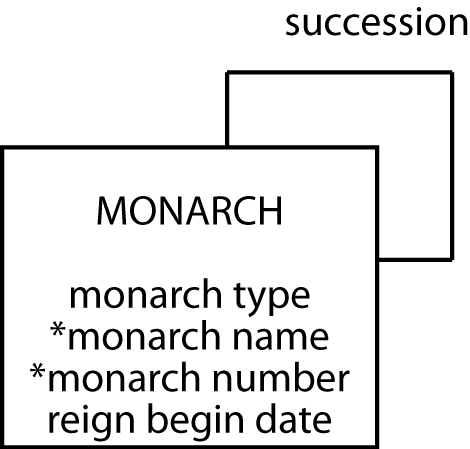
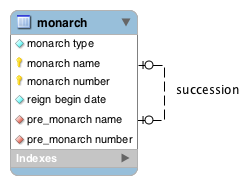
The British monarchy can be represented by a simple one-entity model. A monarch has one direct successor and one direct predecessor. The sequencing of monarchs can be modeled by a recursive 1:1 relationship, shown in the following figure.
A data model illustrating a recursive 1:1 relationship
MySQL Workbench version of a recursive 1:1 relationship
Mapping a recursive one-to-one relationship
The recursive 1:1 relationship is mapped by adding a foreign key to
monarch. You can add a foreign key to represent either the successor
or predecessor relationship. In this case, for no particular reason, the
preceding relationship is selected. Because each instance of a monarch
is identified by a composite key, two columns are added to monarch for
the foreign key. Data for recent monarchs are shown in the following
table.
The table monarch
| montype | monname | monnum | rgnbeg | premonname | premonnum |
|---|---|---|---|---|---|
| King | William | IV | 1830/6/26 | ||
| Queen | Victoria | I | 1837/6/20 | William | IV |
| King | Edward | VII | 1901/1/22 | Victoria | I |
| King | George | V | 1910/5/6 | Edward | VII |
| King | Edward | VIII | 1936/1/20 | George | V |
| King | George | VI | 1936/12/11 | Edward | VIII |
| Queen | Elizabeth | II | 1952/02/06 | George | VI |
The SQL statements to create the table are very straightforward.
CREATE TABLE monarch (
    montype     CHAR(5) NOT NULL,
    monname     VARCHAR(15),
    monnum          VARCHAR(5),
    rgnbeg          DATE,
    premonname      VARCHAR(15),
    premonnum       VARCHAR(5),
    PRIMARY KEY(monname,monnum),
    CONSTRAINT fk_monarch FOREIGN KEY (premonname, premonnum)
        REFERENCES monarch(monname, monnum);
Because the 1:1 relationship is recursive, you cannot insert Queen Victoria without first inserting King William IV. What you can do is first insert King William, without any reference to the preceding monarch (i.e., a null foreign key). The following code illustrates the order of record insertion so that the referential integrity constraint is obeyed.
INSERT INTO MONARCH (montype,monname, monnum,rgnbeg) VALUES ('King','William','IV','1830-06-26');
INSERT INTO MONARCH VALUES ('Queen','Victoria','I','1837-06-20','William','IV');
INSERT INTO MONARCH VALUES ('King','Edward','VII','1901-01-22','Victoria','I');
INSERT INTO MONARCH VALUES ('King','George','V','1910-05-06','Edward','VII');
INSERT INTO MONARCH VALUES ('King','Edward','VIII','1936-01-20','George','V');
INSERT INTO MONARCH VALUES('King','George','VI','1936-12-11','Edward','VIII');
INSERT INTO MONARCH VALUES('Queen','Elizabeth','II','1952-02-06','George','VI');❓Skill builder
In a competitive bridge competition, the same pair of players play together for the entire tournament. Draw a data model to record details of all the players and the pairs of players.ß
Querying a recursive one-to-one relationship
Some queries on the monarch table demonstrate querying a recursive 1:1 relationship.
Who preceded Elizabeth II?
SELECT premonname, premonnum FROM monarch
WHERE monname = 'Elizabeth' and monnum = 'II';| premonname | premonnum |
|---|---|
| George | VI |
This is simple because all the data are in one row. A more complex query is:
Was Elizabeth II’s predecessor a king or queen?
WITH
cur AS (SELECT * FROM monarch),
pre AS (SELECT * FROM monarch)
SELECT pre.montype FROM cur JOIN  pre
    ON cur.premonname = pre.monname AND cur.premonnum = pre.monnum
    WHERE cur.monname = 'Elizabeth'
AND cur.monnum = 'II';| montype |
|---|
| King |
Notice in the preceding query how to specify the ON clause when you have a composite key.
This is very similar to the query to find the salary of Nancy’s boss.
The monarch table is joined with itself to create a row that contains
all the details to answer the query.
List the kings and queens of England in ascending chronological order.
SELECT montype, monname, monnum, rgnbeg
FROM monarch ORDER BY rgnbeg;| montype | monname | monnum | rgnbeg |
|---|---|---|---|
| King | William | IV | 1830-06-26 |
| Queen | Victoria | I | 1837-06-20 |
| King | Edward | VII | 1901-01-22 |
| King | George | V | 1910-05-06 |
| King | Edward | VIII | 1936-01-20 |
| King | George | VI | 1936-12-11 |
| Queen | Elizabeth | II | 1952-02-06 |
This is a simple query because rgnbeg is like a ranking column. It
would not be enough to store just the year in rgnbeg, because two
kings started their reigns in 1936; hence, the full date is required.
❓Skill builder
Who succeeded Queen Victoria?
Of course, Alice soon had another project for Ned. The Expeditioner keeps a wide range of products that are sometimes assembled into kits to make other products. For example, the animal photography kit is made up of eight items that The Expeditioner also sells separately. In addition, some kits became part of much larger kits. The animal photography kit is included as one of 45 items in the East African Safari package. All of the various items are considered products, and each has its own product code. Ned was now required to create a product database that would keep track of all the items in The Expeditioner’s stock.
Modeling a recursive many-to-many relationship
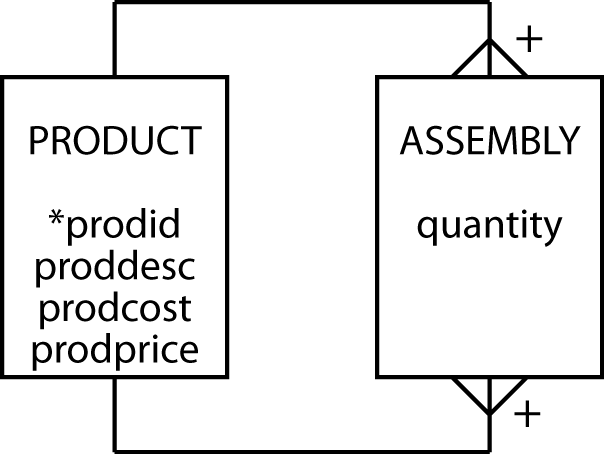
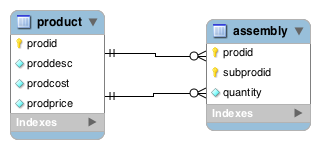
The assembly of products to create other products is very common in business. Manufacturing even has a special term to describe it: a bill of materials. The data model is relatively simple once you realize that a product can appear as part of many other products and can be composed of many other products; that is, we have a recursive many-to-many (m:m) relationship for product. As usual, we turn an m:m relationship into two one-to-many (1:m) relationships. Thus, we get the data model displayed in the following figure.
A data model illustrating a recursive m:m relationship
MySQL Workbench version of a recursive m:m relationship
Tables product and assembly
| prodid | proddesc | prodcost | prodprice |
|---|---|---|---|
| 1000 | Animal photography kit | 725 | |
| 101 | Camera | 150 | 300 |
| 102 | Camera case | 10 | 15 |
| 103 | 70-210 zoom lens | 125 | 200 |
| 104 | 28-85 zoom lens | 115 | 185 |
| 105 | Photographer’s vest | 25 | 40 |
| 106 | Lens cleaning cloth | 1 | 1.25 |
| 107 | Tripod | 35 | 45 |
| 108 | 16 GB SDHC memory card | 30 | 37 |
| quantity | prodid | subprodid |
|---|---|---|
| 1 | 1000 | 101 |
| 1 | 1000 | 102 |
| 1 | 1000 | 103 |
| 1 | 1000 | 104 |
| 1 | 1000 | 105 |
| 2 | 1000 | 106 |
| 1 | 1000 | 107 |
| 10 | 1000 | 108 |
Mapping a recursive many-to-many relationship
Mapping follows the same procedure described previously, producing the
two tables shown below. The SQL statements to create the tables are
shown next. Observe that assembly has a composite key, and there are
two foreign key constraints.
CREATE TABLE product (
    prodid          INTEGER,
    proddesc        VARCHAR(30),
    prodcost        DECIMAL(9,2),
    prodprice       DECIMAL(9,2),
        PRIMARY KEY(prodid));
CREATE TABLE assembly (
quantity INTEGER NOT NULL,
prodid INTEGER,
subprodid INTEGER,
PRIMARY KEY(prodid, subprodid),
CONSTRAINT fk_assembly_product FOREIGN KEY(prodid)
REFERENCES product(prodid),
CONSTRAINT fk_assembly_subproduct FOREIGN KEY(subprodid)
REFERENCES product(prodid));❓Skill builder
An army is broken up into many administrative units (e.g., army, brigade, platoon). A unit can contain many other units (e.g., a regiment contains two or more battalions), and a unit can be part of a larger unit (e.g., a squad is a member of a platoon). Draw a data model for this situation.
## Querying a recursive many-to-many relationship {-}
List the product identifier of each component of the animal photography kit.
SELECT subprodid FROM product JOIN assembly
    ON product.prodid = assembly.prodid
WHERE proddesc = 'Animal photography kit';| subprodid |
|---|
| 101 |
| 102 |
| 103 |
| 104 |
| 105 |
| 106 |
| 107 |
| 108 |
Why are the values for subprodid listed in no apparent order?
Remember, there is no implied ordering of rows in a table, and it is
quite possible, as this example illustrates, for the rows to have what
appears to be an unusual ordering. If you want to order rows, use the
ORDER BY clause.
List the product description and cost of each component of the animal photography kit.
SELECT proddesc, prodcost FROM product
    WHERE prodid IN
        (SELECT subprodid FROM product JOIN assembly
                ON product.prodid = assembly.prodid
                WHERE proddesc = 'Animal photography kit');
In this case, first determine the prodid of those products in the
animal photography kit (the inner query), and then report the
description of these products. Alternatively, a three-way join can be
done using two copies of product.
WITH
a AS (SELECT * FROM product),
b AS (SELECT * FROM product)
SELECT b.proddesc, b.prodcost FROM a JOIN assembly
        ON a.prodid = assembly.prodid
        JOIN b
        ON assembly.subprodid = b.prodid
WHERE a.proddesc = 'Animal photography kit';| proddesc | prodcost |
|---|---|
| 35mm camera | 150.00 |
| Camera case | 10.00 |
| 70-210 zoom lens | 125.00 |
| 28-85 zoom lens | 115.00 |
| Photographers vest | 25.00 |
| Lens cleaning cloth | 1.00 |
| Tripod | 35.00 |
| 24/100 ASA 35mm color neg film | 0.85 |
❓Skill builder
How many lens cleaning cloths are there in the animal photography kit?
Summary
Relationships can be one-to-one and recursive. A recursive relationship is within a single entity rather than between entities. Recursive relationships are mapped to the relational model in the same way as other relationships. A self-referential foreign key constraint permits a foreign key reference to a key within the same table. Resolution of queries involving recursive relationships often requires a table to be joined with itself. Recursive many-to-many relationships occur in business in the form of a bill of materials.
Key terms and concepts
| JOIN | Relationship |
| One-to-many (1:m) relationship | Relationship descriptor |
| One-to-one (1:1) relationship | Self-join |
| Recursive 1:1 relationship | Self-referential foreign key |
| Recursive 1:m relationship | Theta-join |
| Recursive m:m relationship | Update anomalies |
| Recursive relationship | Views |
| Referential integrity | Virtual table |
Exercise
Draw data models for the following two problems:
A dairy farmer, who is also a part-time cartoonist, has several herds of cows. He has assigned each cow to a particular herd. In each herd, the farmer has one cow that is his favorite—often that cow is featured in a cartoon.
A few malcontents in each herd, mainly those who feel they should have appeared in the cartoon, disagree with the farmer’s choice of a favorite cow, whom they disparagingly refer to as the sacred cow. As a result, each herd now has elected a herd leader.
The originator of a pyramid marketing scheme has a system for selling ethnic jewelry. The pyramid has three levels—gold, silver, and bronze. New associates join the pyramid at the bronze level. They contribute 30 percent of the revenue of their sales of jewelry to the silver chief in charge of their clan. In turn, silver chiefs contribute 30 percent of what they receive from bronze associates to the gold master in command of their tribe. Finally, gold masters pass on 30 percent of what they receive to the originator of the scheme.
The legion, the basic combat unit of the ancient Roman army, contained 3,000 to 6,000 men, consisting primarily of heavy infantry (hoplites), supported by light infantry (velites), and sometimes by cavalry. The hoplites were drawn up in three lines. The hastati (youngest men) were in the first, the principes (seasoned troops) in the second, and the triarii (oldest men) behind them, reinforced by velites. Each line was divided into 10 maniples, consisting of two centuries (60 to 80 men per century) each. Each legion had a commander, and a century was commanded by a centurion. Julius Caesar, through one of his Californian channelers, has asked you to design a database to maintain details of soldiers. Of course, Julius is a little forgetful at times, and he has not supplied the titles of the officers who command maniples, lines, and hoplites, but he expects that you can handle this lack of fine detail.
A travel agency is frequently asked questions about tourist destinations. For example, customers want to know details of the climate for a particular month, the population of the city, and other geographic facts. Sometimes they request the flying time and distance between two cities. The manager has asked you to create a database to maintain these facts.
The Center for the Study of World Trade keeps track of trade treaties between nations. For each treaty, it records details of the countries signing the treaty and where and when it was signed.
Design a database to store details about U.S. presidents and their terms in office. Also, record details of their date and place of birth, gender, and political party affiliation (e.g., Caluthumpian Progress Party). You are required to record the sequence of presidents so that the predecessor and successor of any president can be identified. How will you model the case of Grover Cleveland, who served nonconsecutive terms as president? Is it feasible that political party affiliation may change? If so, how will you handle it?
The IS department of a large organization makes extensive use of software modules. New applications are built, where possible, from existing modules. Software modules can also contain other modules. The IS manager realizes that she now needs a database to keep track of which modules are used in which applications or other modules. (Hint: It is helpful to think of an application as a module.)
Data modeling is finally getting to you. Last night you dreamed you were asked by Noah to design a database to store data about the animals on the ark. All you can remember from Sunday school is the bit about the animals entering the ark two-by-two, so you thought you should check the real thing.
Take with you seven pairs of every kind of clean animal, a male and its mate, and two of every kind of unclean animal, a male and its mate, and also seven pair of every kind of bird, male and female. Genesis 7:2
Next time Noah disturbs your sleep, you want to be ready. So, draw a data model and make certain you record the two-by-two relationship.
Write SQL to answer the following queries using the DEPT and EMP tables described in this chapter:
Find the departments where all the employees earn less than their boss.
Find the names of employees who are in the same department as their boss (as an employee).
List the departments having an average salary greater than $25,000.
List the departments where the average salary of the employees, excluding the boss, is greater than $25,000.
List the names and manager of the employees of the Marketing department who have a salary greater than $25,000.
List the names of the employees who earn more than any employee in the Marketing department.
Write SQL to answer the following queries using the monarch table described in this chapter:
Who succeeded Victoria I?
How many days did Victoria I reign?
How many kings are there in the table?
Which monarch had the shortest reign?
Write SQL to answer the following queries using the product and assembly tables:
How many different items are there in the animal photography kit?
What is the most expensive item in the animal photography kit?
What is the total cost of the components of the animal photography kit?
Compute the total quantity for each of the items required to assemble 15 animal photography kits.